
Twenty
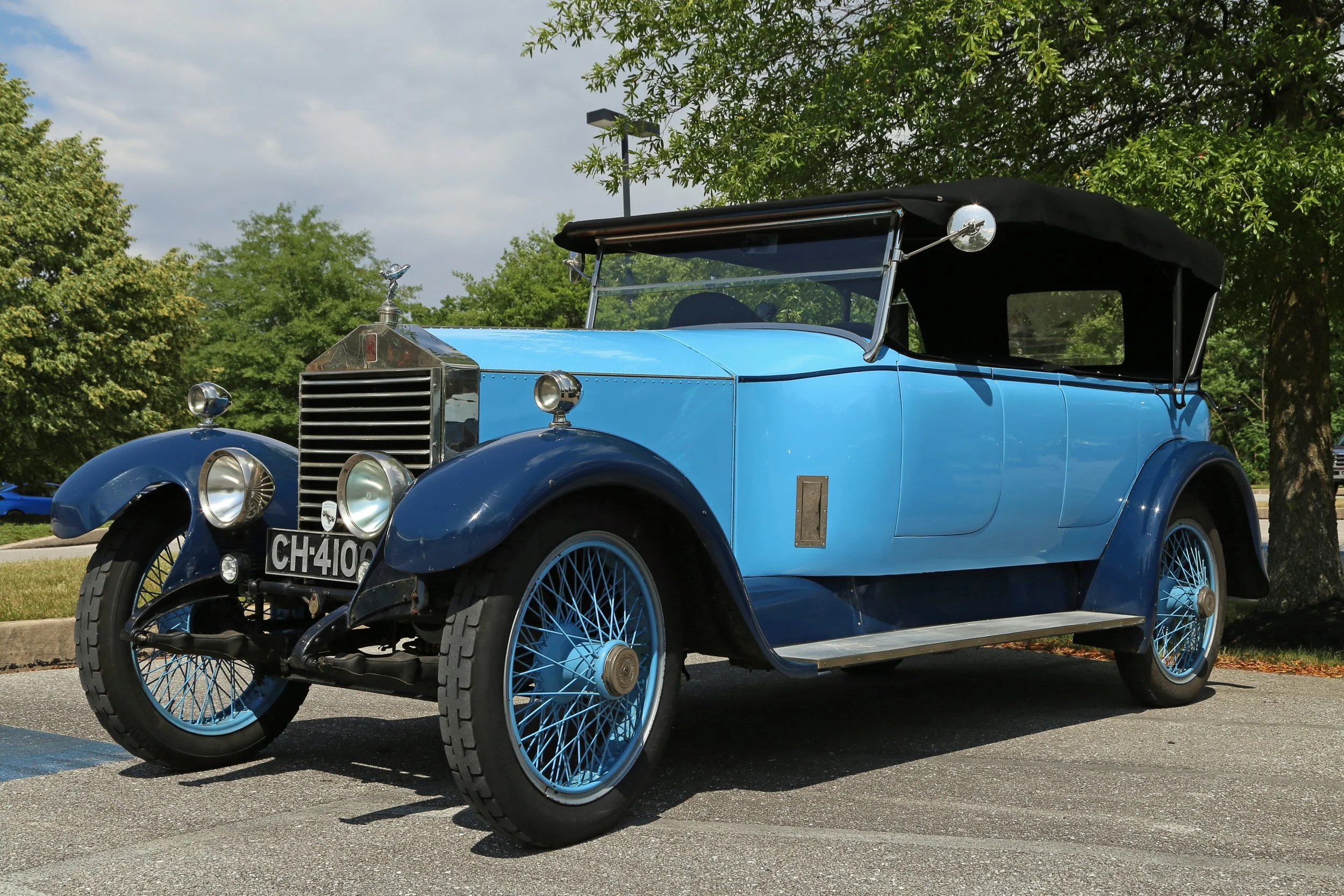
Introduced as an owner-driver car for the 1920s, this smaller Rolls-Royce was produced from 1922 to 1929 alongside the larger 40/50 Silver Ghost and its successor, the Phantom. Total production was 2,940. For more information, including technical specifications and chassis series, see Rolls-Royce Motor Cars, Wikipedia, and Fiennes Parts, Ltd.
The legendary 20 H.P., known simply as the ‘Twenty’, was launched on 6 October 1922. Designed by Henry Royce, it ranks among the most important and transformational models ever produced by the marque. Its technology was highly advanced for the time and set the mechanical template for generations of Rolls-Royce motor cars that followed it. Smaller, lighter and less complex than its predecessors, it was also the first Rolls-Royce specifically intended for owners to drive themselves, rather than chauffeured use, reflecting the changed world in which Rolls-Royce found itself operating after 1918. More than a century later, its influence can still be seen in contemporary automotive engineering and design, including the models we build at Goodwood today – a remarkable motor car with an extraordinary legacy.” Andrew Ball, Head of Corporate Relations and Heritage, Rolls-Royce Motor Cars

MotorSport Magazine , Book Reviews, July 1979, Author: Bill Boddy
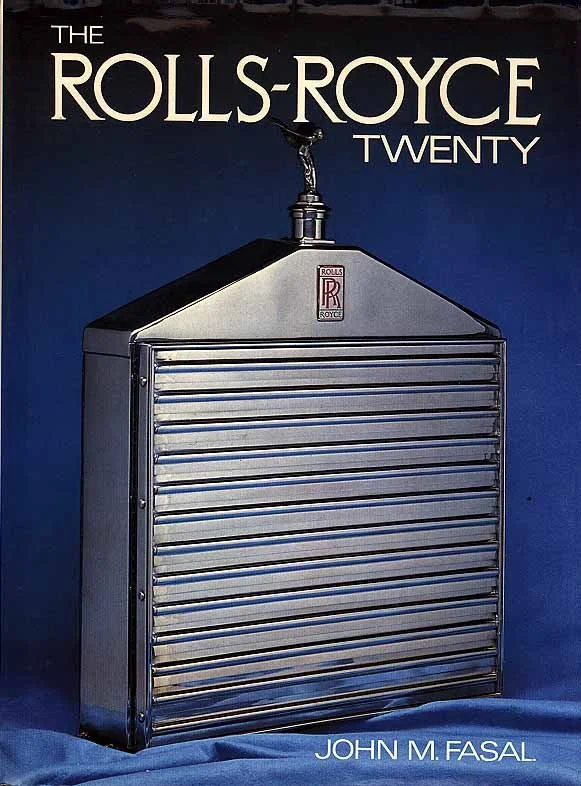
“The Rolls-Royce Twenty” by John M. Fasal. 560 pp. 10” x 7”. (Burgess & Son Ltd., Station Road, Abingdon, Oxon. £28.50).
John Fasal, who runs a company devoted to repairing and restoring them, fell in love with the Rolls-Royce Twenty in 1964 and has been devoted to them ever since. So devout has been this love-affair that he knows more about them, and about the Rolls-Royce Company itself I would think, than any other historian. He examined every Twenty and its derivatives that he could discover, which took him as far afield as America, Australia and even to remote palaces in India. This remarkable accumulated knowledge has now surfaced in this unique book, which must be the ultimate in Rolls-Royce history.
There have been plenty of books on this ever-fascinating and once seemingly inexhaustible subject; John Fasal numbers them as at least seventy. Yet in his own work he discloses so many new facts and facets about the cars and the Company that made them that words almost fail this reviewer in contemplating the impact “The Rolls-Royce Twenty” is going to have onthose Rolls-Royce fanatics fortunate enough to read it, and on motoring historians in the years ahead. Because the author, when not driving his own collection of the smaller Rolls-Royce motor-cars, has spent seemingly all his time uncovering the hidden details of the Rolls-Royce story that so many of us had wanted to know, and which we will now hold dear.
I find it difficult to know where to begin. For instance, Fasal has listed every Rolls-Royce Twenty made, this table occupying 55 close-packed pages of his book, a table which lists the engine number, chassis number, type of coachwork, the coachbuilder, the car number, Reg. No., name of original owner, location, and (where known) the present owner of all the 20s, from the first eleven experimental cars through the production models, to the last 20/25. A formidable slice of history in itself.
As the chapters unfold, more such detailed information is included. Some of the early Company history and the reasons leading up to the introduction of the 20 h.p. model in 1922 have naturally appeared elsewhere, notably in the great Batsford and Ian Lloyd Macmillan Rolls-Royce books, etc., but it is the little (and not so inconsiderable) additions that make Fasal’s work so enthralling. He includes intimate items from Rolls-Royce Board minutes and when, for instance, he covers the Design-Team based at West Wittering he lists all the personnel, from F. H. Royce downwards, with details of where they came from before joining Rolls-Royce, and their respective task. It is the same all through the book – everyone listed, photographs of almost everything relevant, with almost endless data about the development and testing of the Twenties. The Rolls-Royce Schools of Instruction and Repair Depots (even to plans of the actual premises), and so on, are just a fascinating part of the whole story.
The book carries interior pictures of the Derby factory that are new to me and, as I have said, it lists almost all the Rolls-Royce personnel of the 1920s, even those in the London Sales Department, reveals what befell some of the Rolls-Royce Travelling Inspectors and how they induced fresh sales (I would have enjoyed more of this), reveals how chauffeurs might expect to be reimbursed if they were able to persuade their employees to invest in a new Rolls-Royce (!), and in every way it rounds off the Rolls-Royce story so that any writers who hope to obtain anything to add to the past history of Rolls-Royce will have to be extraordinarily industrious – and then I expect John will beat them to it’; he is already at work on a book about Rolls-Royce in India . . .
One comes back again and again to the completeness of this work and not only from the aspects of the Rolls-Royce Twenty. There are photographs of all Royce’s houses, of Royce in experimental Rolls-Royce cars, portraits of the Rolls-Royce Directors and others who were at the helm of this remarkable British institution, of Overseas Depots, and of course, every facet of all the Twenties seems to have been illustrated. It is incredible – there is even a photograph of a Roll-Royce Company envelope (which, like the cars, had character), there is a colour-plate of heraldic devices and monograms used on Rolls-Royce cars, there are even lists of the numbers of pupils who attended the Rolls-Royce Training Schools, and some of the chassis record-card and a picture of the nickel chassis-plate of Sir Max Pemberton’s famous Twenty are there. I really am obliged to add “etc., etc.”, if I am to end this review – for the book even has the list of all the guests at the retirement luncheon for Basil Johnson, a “family tree” of every member of the Rolls-Royce London Repair Depot “N” at the relevant time, details of bodywork on the early “Goshawk” cars, minutes from “R” to his engineering staff, while coachwork on the Twenties gets almost a separate book on its own account.
Doing justice to such a comprehensive tome on such a high-category subject demands a top-class publisher. Burgess & Son have done a magnificent job for John Fasal in this respect. “The Rolls-Royce Twenty” is printed clearly on glossy top-quality art paper and it contains an enormous collection of photographs, beautifully reproduced, so many that even the most avid Rolls-Royce fans must surely find many that are new to them – like Royce’s set of drawing instruments (now in John’s ownership), a reproduction of an original 1924 Royce memo. from Le Canadel, and pictures of all the 20s imaginable, even to near-derelict specimens found in post-war days. It is not possible to list here all the tables and diagrams – the Rolls-Royce Patents, listed improvements to the Twenty, the notes on “Goshawk” modifications that over pages and pages, etc. The original road-test report from The Motor is reproduced, together with an early one from The Auto (but not the one from The Autocar, because IPC wished to reserve this for their own Rolls-Royce book), as are later impressions of the Twenty, for example Cecil Clutton’s article in Motor Sport of 1942. There are some fine colour-plates, pictures of the Rolls-Royce tool-kit, coachwork drawings, shipping details, lists of Rolls-Royce publications from 1922-1930, of Press road-test reports on the 20 h.p. cars and chassis, body mounting and spares details, a bibliography, list of sources, material on individual cars, and an index. Comdr. Hugh Keller, RN, Rtd. has contributed an appreciation of the Rolls-Royce Twenty.
I may well return to this book in more detail at some later date. For the moment, the only adjective I can think of is “Magnificent”. – W. B.