
Stories
Owners and their cars have stories to tell and lessons to share. In this section, we’ll tell some of those stories. If you have one to include please contact us.
Also note that every edition of the Goshawk Society’s newsletter, the Flier, has an article about a car and some aspect of its history. Sometimes it’s about the owner, sometimes about a major restoration project, other times it’s the motor car’s history. Make a cup of tea or pour a good single malt, go over to the Flier archive, and read a few good stories.
The History of a 1935 20/25 Shooting Brake, GPG78
Owner: Douglas Kniff
GPG 78 started out life with coachwork from Hooper. It was one of Hoopers standard design catalog item 5951 I’m sure with the usual custom appointments as ordered by the original purchaser. This particular catalog number indicates it was a 4 door 4 light sedanca de ville or town car as we here in the states would refer to the design. This certainly would be an attractive limousine today as it was then, had it survived. The Hooper limousine was delivered originally ordered and delivered to Captain Simon Orde who also was an Earl but did not go by that title during service to the King.
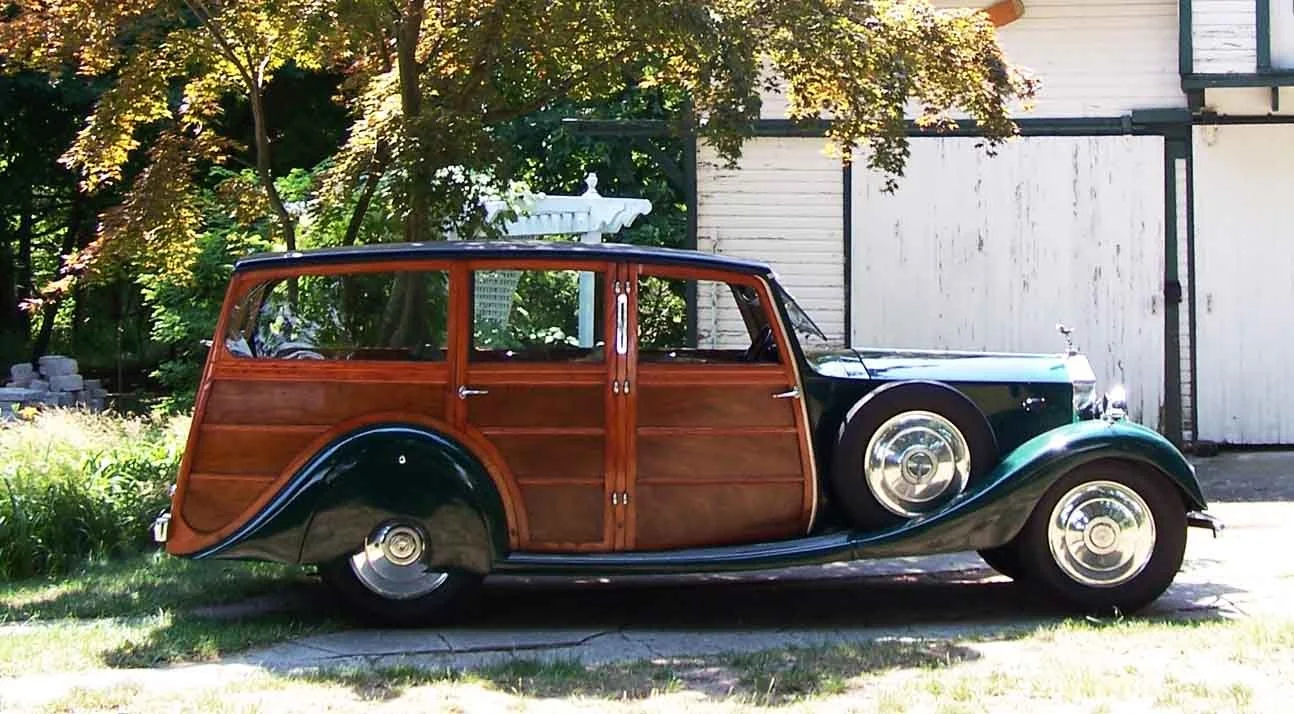
I don’t take it as too much of a surprise that he was an Earl as I doubt the wages of even a Captain would allow the means to acquire a Rolls Royce. What I believe is one of the custom appointments and are still with the car are the five forward looking Marchal lamps. My good guess is that the Captain probably, as duty would require, would be expecting to do some continental travel. France prior to the war had an ordinance on automobile lighting requiring two rather than one low dip. Hence the large lamps today still have high beam, low beam, and low-low beam as required for city driving, along with the additional matching spot lamps for touring the countryside late evenings. Another remnant retained from the Hooper coachwork are the wings. They have that very Hooper coachwork character, especially the rear wheel spats that are not very fitting for a total makeover into a shooting brake that give the auto a unique art deco carryover look. Captain Orde was a captain in the Army with offices in London then. This ended up being the Hooper coachworks undoing. During WWII, as it happened, the Rolls Royce was in London as one of the bombing raids took place and a portion of a building fell damaging the coachwork beyond use. For the remainder of the war then, GPG78 sat in idle storage not to be repaired as all production was dedicated to the war effort. As here in the states, all peacetime production especially coachwork was prohibited.
When hostilities ceased peacetime automobile use was in huge demand. GPG78 made for a perfect candidate to be rebodied. A couple with an estate were put in touch with the Rolls Royce as they had a use for a hunting transport. This couple with an estate in England , aptly had a title, and their name was Lord and Lady Feather. Through Windovers the Rolls Royce was purchased and commissioned to have the “shooting brake” coachwork constructed.
Windovers were established in Huntingdon in 1796 and were the originators and patentees of a great number of designs and improvements in coach building before the motor car. Once the motoring era had arrived it was realized that Huntingdon was too far from the source of clients and chassis, and as a result a factory was acquired in the early twenties at Collindale near London .
In this factory were built the bodies for mounting on Rolls-Royce chassis, many going to India as Windovers had a large clientele among Indian Princes. During the 1939-45 War they concentrated on aircraft component manufacture, after which they turned their attention to motor coach body construction and one of their coaches was selected by the Council of Industrial Design to be exhibited in the Transport Pavilion at the Festival of Britain, 1951.
GPG 78 had hunting coachwork done by Windovers including solid Ash framing with interior and exterior done in Russian Plywood.
Coach building on Rolls-Royce chassis continued after the war until 1956 when the company was taken over by Henley 's Ltd., and all the coach building, private and commercial ended.
Lord and Lady Feather owned the Rolls Royce until sometime into the early to mid 50’s at which time it was put up and made available. The new owner Wallace DuPont who was a scion of the chemical fortune purchased the shooting brake for use as an estate wagon on his estate in Delaware . Upon arrival in the United States the Rolls Royce was repainted the DuPont family color of maroon and rather unfittingly fitted with American truck lamps for turn signals. With trafficators broken or disconnected she was placed into service. Wallace DuPont owned the vehicle until his untimely demise. Wallace was murdered in the early 60’s by thieves for his rare stamp collection. This ended up being exactly how the thieves were eventually apprehended by trying to peddle some of the rare stolen stamps that led the police almost directly to the culprits. For the next ten or more years the shooting brake remained tied up in the estate, I believe out of doors much of the time until an auto broker from Connecticut found it and purchased the shooting brake relieving the Rolls Royce from its unknown future.
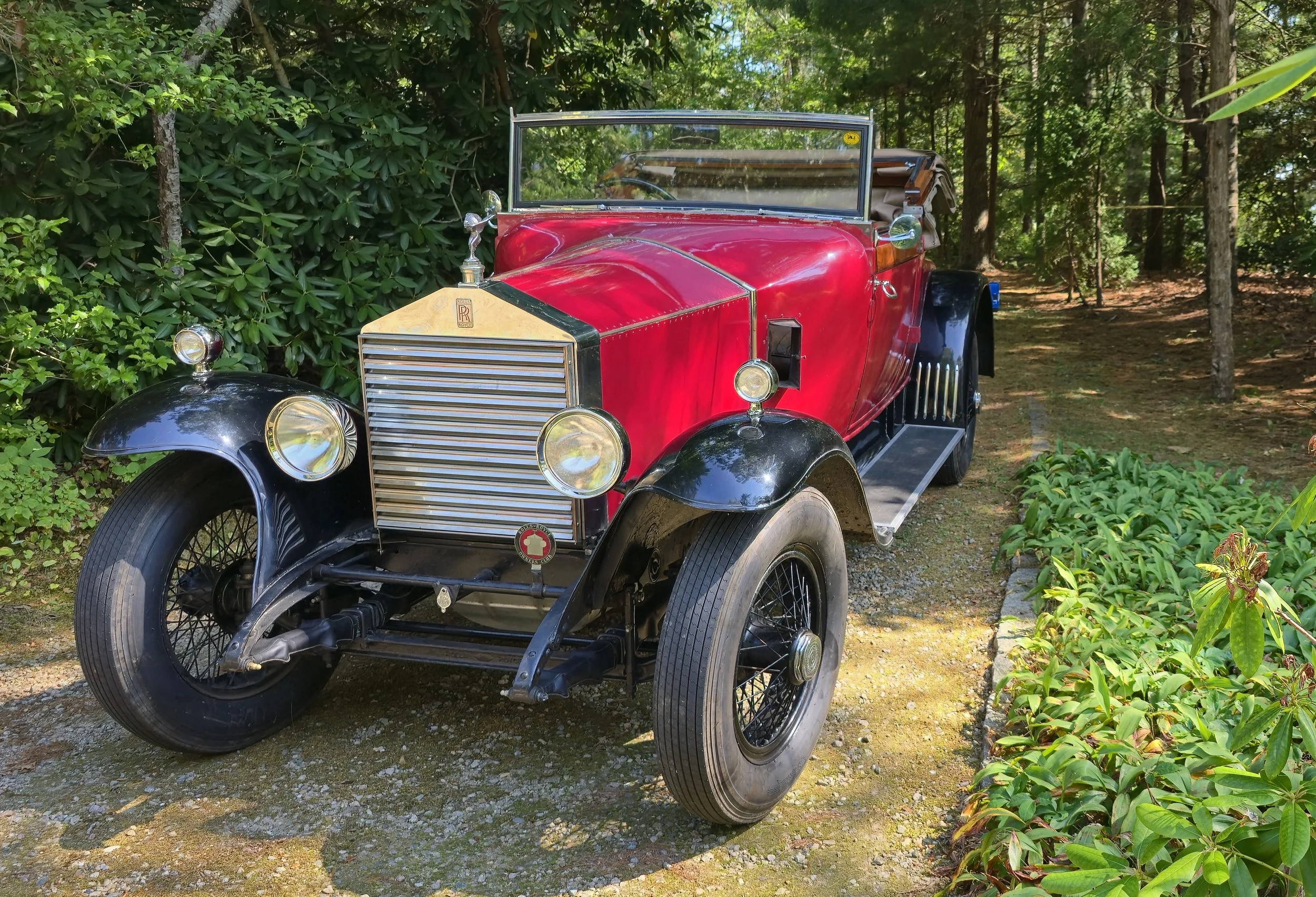
1923 20HP Barker Drophead Doctors Coupe, 89K1
Owner: Rick Otis, RROC Chesapeake Region
If memory serves, it wasn’t raining in southern New England on Monday, October 7, 1963. Not long after breakfast, Dad, number two son, and the family’s new Ford Country Sedan station wagon with trailer in tow headed out for Huntington, Long Island. The goal was to purchase a 1923 Rolls-Royce and bring it back over the new Throgs Neck Bridge and up the Merritt Parkway to central Connecticut. Strapped to the trailer were two 10x1 foot maple planks normally used as seats for the family picnic table.


1933 Rolls-Royce 20/25 3 position drophead coupe
Courtesy of Stephe Boddice
Basic data
Year manufactured........ : 1933
Chassis number............. : GGA27
Engine number............... : E8L
Engine type..................... : Straight 6 - 3587cc - 25hp
Coach builder................. : Lamorna
Registration number....... : AUW577
Body style......................... : 3 position drop head coupe
Body colours..................... : Black over burgundy with gold coachlines
Interior................................ : Tan leather
General description
Exterior
The car was re-bodied in 1988 to a design influenced by HR Owen: all ash framing and aluminium panel work is new as of that date. The paint work is in very good condition, though not to concourse standard due to the vehicle’s regular use. The hood is made from mohair with a small rectangular window in the rear. Hinged external pram-irons hold the rear section in tension assisted by 4 external and 4 internal Durable Dot fasteners on each side. It can be erected in three positions - fully closed, front section open and fully open. All body shut lines are correct with no evidence of sagging on either door. Both doors are fitted with external key operated dead-bolt locks. The front lamps have been modified to give dipped beam through the Lucas P80s and main beam via the Cibies. Brake lights and flashing indicators were added to the car in 1989 to improve driving safety. The car retains trafficators and the flashers are easily de-mounted. One reversing light and one high intensity rear light have been mounted discretely beneath the spare wheel. The exterior boot box is side opening; locks and catches being located on the nearside.
Interior
Woodwork is in mahogany with black detail lines. Upholstery and door linings are in tan hide, all being in first class order. Door bottoms and the bottom rear sections of the front seats are covered in oatmeal carpet to avoid damage to the leather work. Floor covering is in fitted coir matting which is far more effective in this style of body. Both front seats are mounted on sliding runners that give a full range of adjustment as well as allowing access to the rear compartment. The back of the rear seat is bottom-hinged to give access to a reasonably large storage compartment . The inside of the hood is lined in beige woollen cloth with a courtesy light mounted in the forward head rail. Forward location of the hood onto the windscreen is by two spring-loaded pins that locate in pegs on top of the A posts. The hood is completely weatherproof when erected. The original dash board instruments and switches are all present and working. Out of sight, beneath the scuttle rail at the base of the windscreen, are the switches for the overdrive and reversing/high intensity rear lights. Warning lights are recessed into the face of the scuttle rail. A heater and de-mister is mounted behind the dashboard with a fan control rheostat at the base of the dash.
Mechanical
This is possibly the best running 20/25 in existence. The water temperature operates between 70C and 80C with a hot running oil pressure of 20psi at 50mph (factory specification was 18psi) - tick-over at 10psi. In 1988, during its initial rebuild, its original engine was re-sleeved back to standard specification, having new pistons and bearings fitted. During the last 10 years the car has undergone a complete mechanical overhaul.
The following list summarises the restoration work :-
Radiator re-cored and new calorstat fitted
Engine rebuilt with new big ends - water jacket cleaned out
Head replaced with full conversion to unleaded
Water pump, dynamo and magneto rebuilt
Starter motor and starter clutch overhauled
Carburettor, Autovac and distributor overhauled
Steering box and column rebuilt
Front axle, brake levers, A brackets re bushed and swivel pins rebuilt
Front and rear brakes rebuilt - rear brakes relined in 1999. All wheel bearings replaced
Gearbox rebuilt with new bearings
Overdrive unit fitted - operates on 3rd and 4th gears with automatic de-selection when changing into second/neutral.
The original propeller shaft, though not fitted, has had the Hook joints rebuilt.
Rear axle differential stripped and checked
One-shot system completely overhauled
Stainless steel exhaust system was fitted in 1997
Rear spring rear shackle pins and bushes replaced in 2001
History
The car was originally ordered via Joseph Cockshoot & Co. Ltd, of Manchester, by Alexander & Garner Ltd on behalf of Miss Deakin of Egerton, Bolton. The original order was for an enclosed limousine by Barker & Co.. Factory records show that it was sold on 30th December 1947 and again on 9th December 1949; after which the trail stops. Two unnamed owners are noted on the log book between November 1983 and 1988. Richard W Blake of Lamorna Restorations, Cornwall, who rebuilt the car, acquired it on 20th January 1988. By that time it was in a parlous state, having had the roof cut off to make an ‘open’ car. Following restoration, the car was featured at the International Classic Car Show at Alexandra Palace in April 1989 and was the subject of a half page feature in The Daily Telegraph on 1st May 1989.
The pinnacle of its achievements was to complete LeJOG in December 1997 and December 1999 without breakdown. In 1997 the car was awarded the Concourse prize for the touring event! On both occasions the car covered over 2,400 miles in 8 days including daily averages of 400 miles during the 3 days of the event - mainly on B and unclassified roads.